
View Client Profile
To reach the Profile page of an existing Client, navigate to Clients > Clients List submodule:

On the Clients List, click on the Name of the Client and navigate to the Client Profile page:
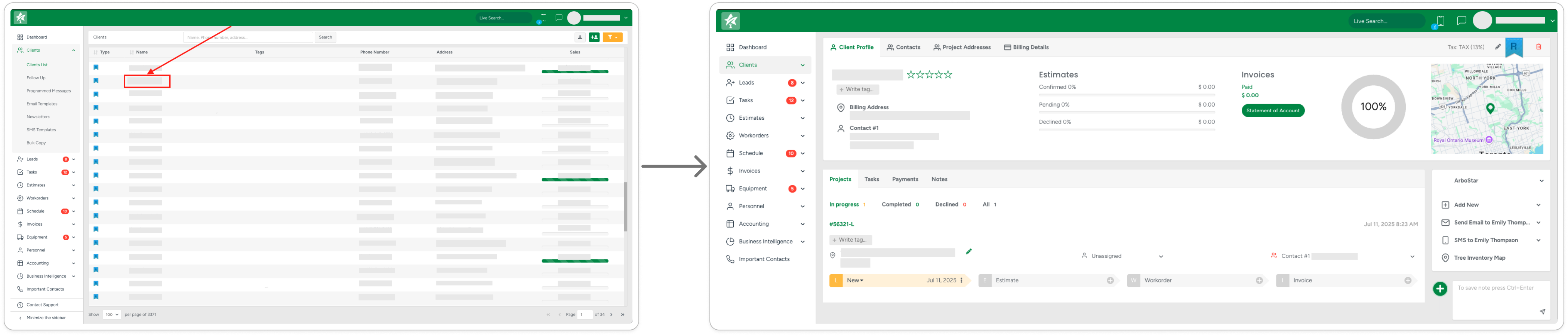
On the Client Profile, you can see the general information about the Client, send emails or SMS, create Estimates, and more.
Edit Client Profile
On the Client Profile page > Client Profile tab, you can view and edit the Client's general information. A map on the right displays the Client's location:
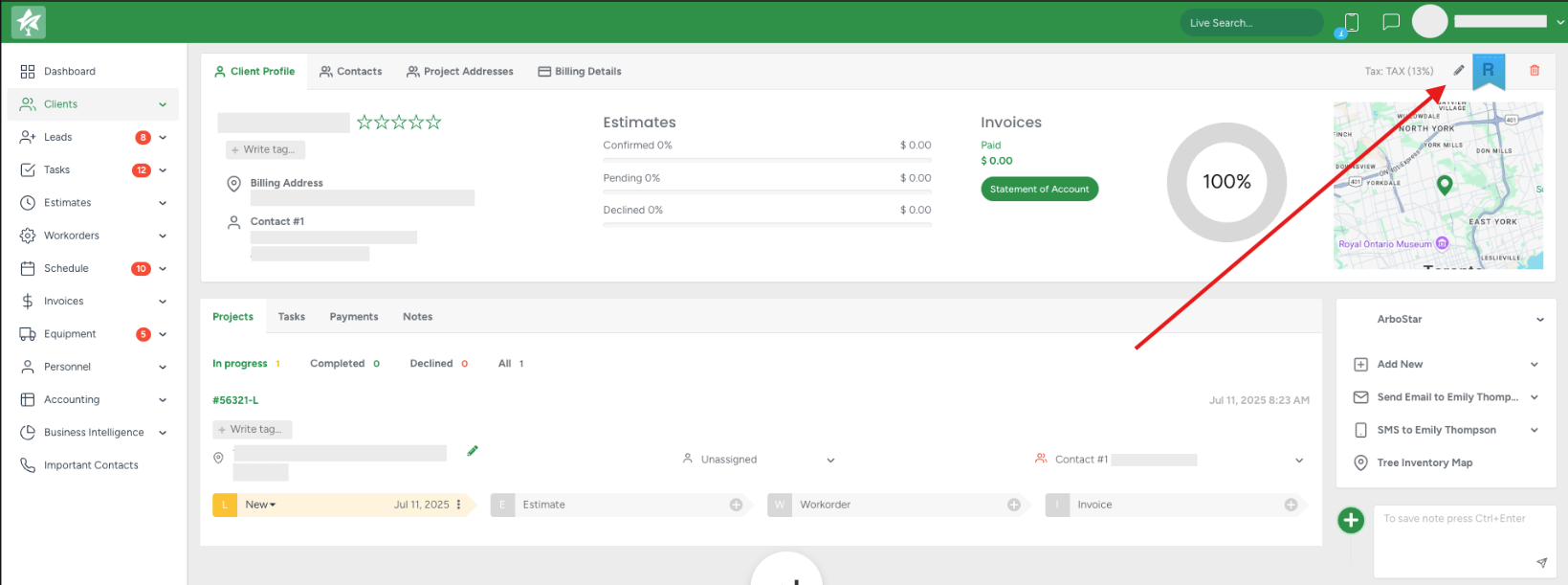
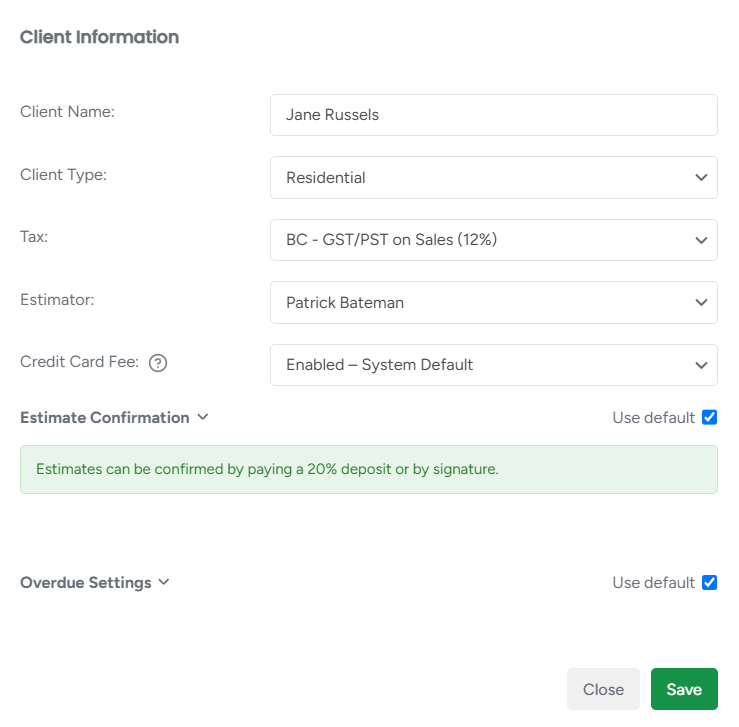
Clicking the pencil ✏️ icon lets you edit the client's information.
- Client Name. The client's name as it appears across the system.
- Client Type. Choose between Residential, Commercial, and Municipal.
- Tax. Choose one of the taxes configured in Company Management. Tax rates are added, edited, and removed in the Prices Management section there.
The tax you select here becomes the default for every new Lead created for this client, and it can still be changed on an individual case if needed. U.S. companies can also enable Auto Tax, which applies the correct rate automatically based on the address. Adding, editing, and removing tax rates is configured in the Prices Management section of Company Management.
- Estimator — set a default estimator for this client. They will be prefilled on every new project created for this client, which is useful for maintaining a strong relationship with a key account. The estimator can still be changed on an individual project.
- Credit Card Fee — select Enabled to pass the credit card fee on to the client, or Disabled to cover it yourself, as you might for a key account.
Estimate Confirmation
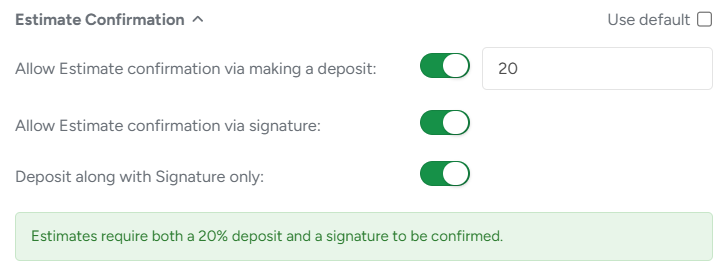
Decide how this client confirms an estimate. By default, the client follows the settings configured in Company Management or in the Brand Settings. To set rules just for this client, untick Use default and configure:
- Allow Estimate confirmation via making a deposit. Toggle on and enter the deposit percentage required.
- Allow Estimate confirmation via signature. Toggle on to accept a signature as confirmation.
When both settings of the above are on, the client can choose either method.
- Deposit along with Signature only. Toggle this on to require both methods simultaneously.
Overdue Settings
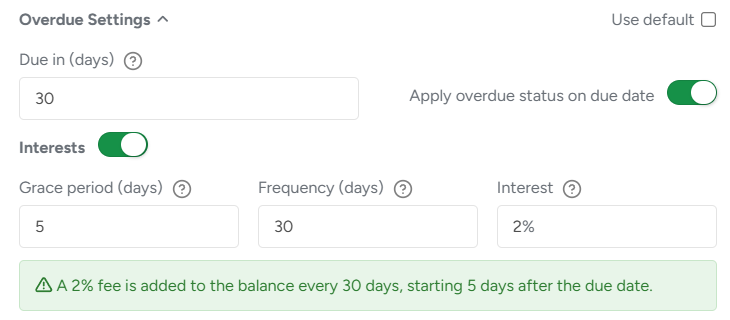
Control when this client's invoices become overdue and whether interest is charged. By default, the client follows the settings configured in the Company Management section or in the Brand Settings. To set rules just for this client, untick Use default and configure:
- Due in (days). Days from invoice creation until payment is due. This appears as the Due Date on the invoice PDF and in the Client Portal. Enter
0for invoices due on receipt. - Apply overdue status on due date. Toggle on to auto-change the invoice status to "Overdue" once the due date is reached. With the toggle off, the invoice never receives the "Overdue" status and stays in its original status until the client pays.
- Interests. Toggle on to charge interest on overdue invoices.
The three fields below apply only when this setting is on.
- Grace period (days). Buffer period after the due date before interest begins. Enter
0to start charging on the due date itself. - Frequency (days). How often interest is charged once the grace period ends (for example, every 30 days).
- Interest (%). The percentage added to the unpaid balance at each interval (for example, 2% every 30 days).
The green note under each block summarises the rules you have just set, so you can confirm at a glance that they match what you intended.
The following client information can also be edited:
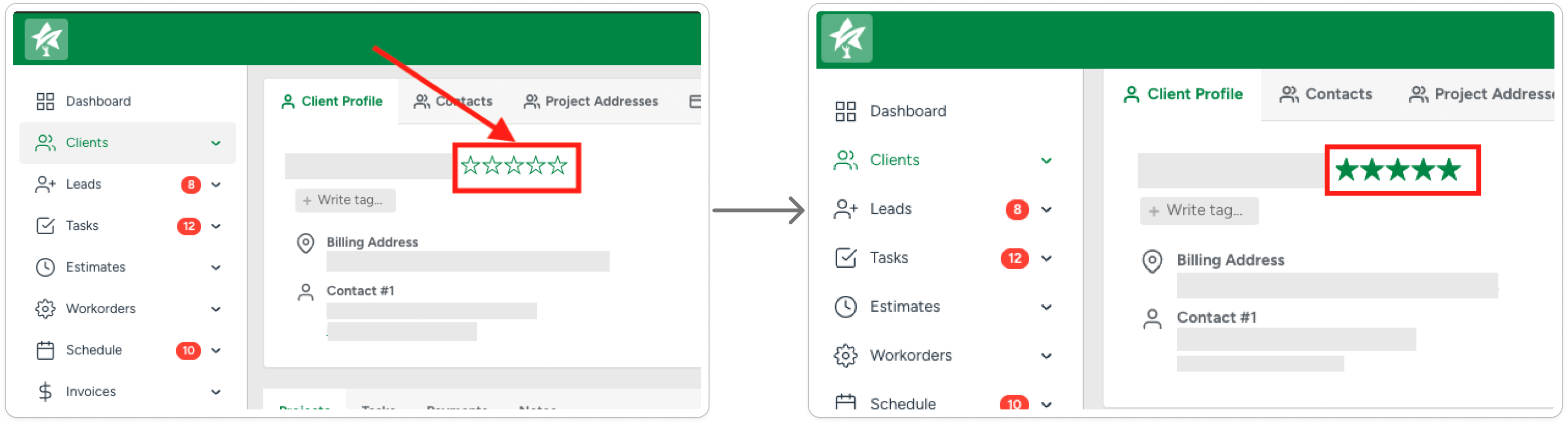
Client's Rating: Select the desired number of stars (1-5) to rate the Client.
Tags: By clicking it, you can create a new tag or choose (auto-complete option) an already existing one:
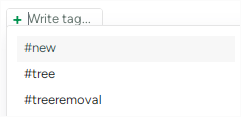

Tags are used to filter Clients in the Clients List and throughout the platform. When you search by Tag by simply clicking on it in the list, the system will display all Clients associated with that Tag.
For existing Clients, you can add a new tag to the Client's profile by entering it in the Tag field. To remove an existing Tag, simply click the 'Remove' icon.
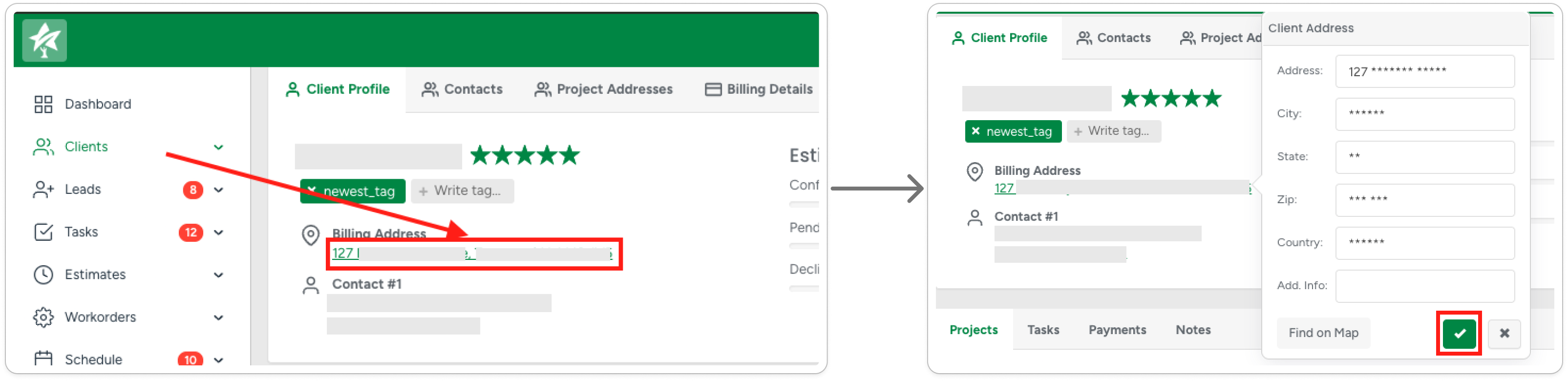
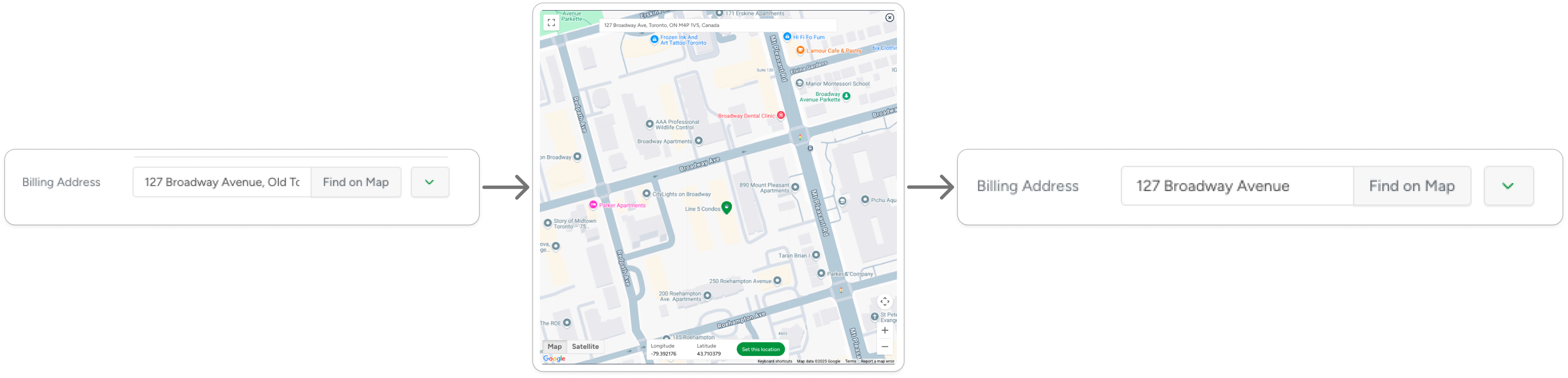
- Billing Address: To initiate editing the Address, click on the address line. In the Edit Address form, change the information with valid data and save the changes to update the Billing Address:
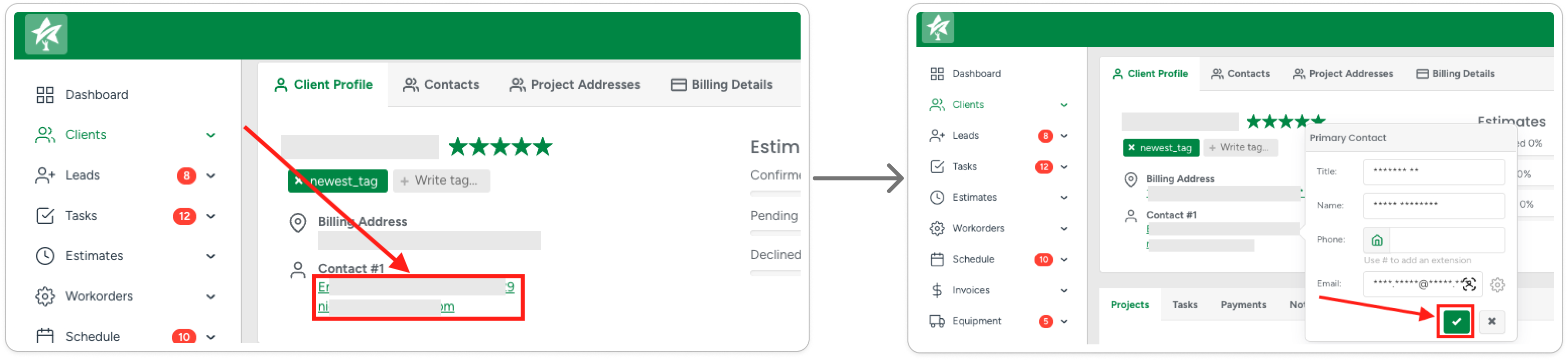
- Contact: To edit the Client's Primary Contact data (Title, Name, Phone, Email), click on the Client's Contact information line, edit the necessary data, and submit the changes:
Delete Profile
To initiate the Client Profile deletion, click the 'Remove' icon. On the removal confirmation, enter the password and confirm the removal:
Please note that the Admin-level access is required to confirm the deletion process. Once a Client Profile is deleted, it cannot be restored.
Merge Profile
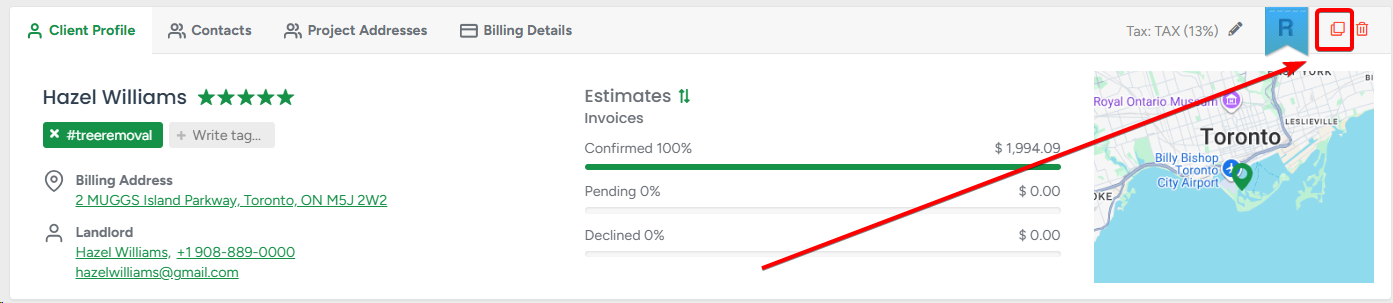
If you want to merge two clients' profiles, click on the merge button at the top right:
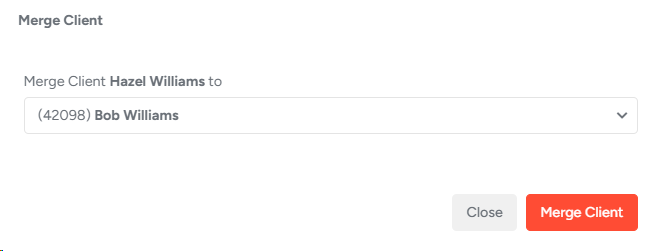
Then choose a client you want this profile to be merged to, and click "Merge client"
Note: you won't be able to merge two clients if you already have an active accounting integration.
Contacts
- To view and manage the Client's Contacts, click the Contacts tab:

Edit Contacts:
- Add new Contact: Click the '+' icon to add additional Contact. Then, enter the required information in the pop-up window:

- Edit Contact info: To initiate editing, click the 'Edit' icon. On the Edit Contact form, change the necessary data and submit the changes.
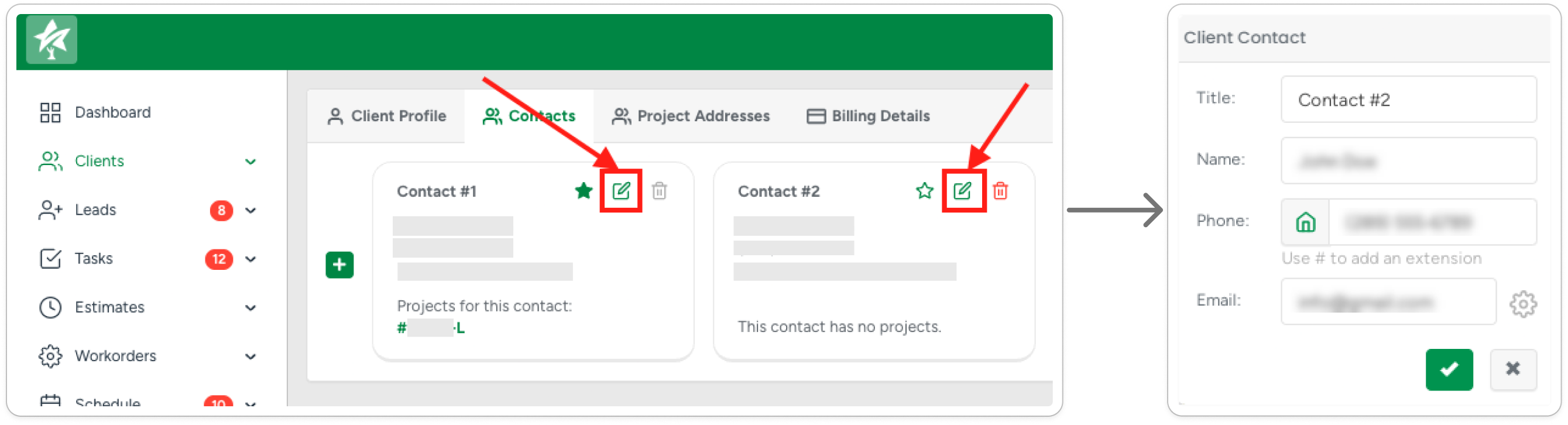
- Mark as Primary: Mark Contact as Primary by clicking the 'Primary' icon. Only one Contact can be marked as Primary: selecting new Primary Contact unmarks the previous Contact:

- Remove Contact: To initiate the Contact removal, click the active 'Remove' icon. On the confirmation pop-up, confirm the removal:
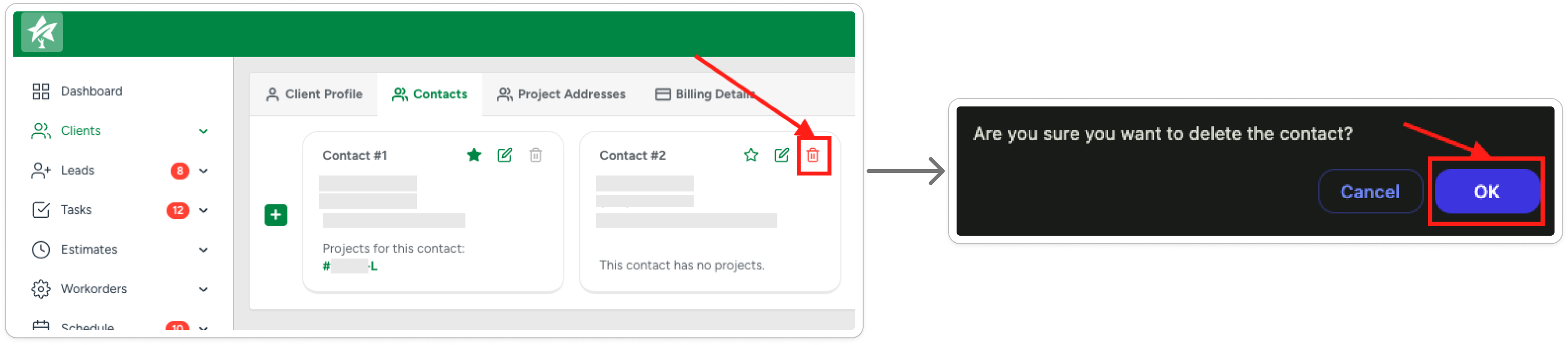
The Primary Contact can not be deleted: mark a different Contact as Primary to allow the removal. If only one Contact is added, it becomes Primary automatically and
Projects Addresses
The Project Addresses section allows you to assign custom names to project locations. These names will appear on the Estimate PDF, Invoice PDF, and in the Customer Portal.
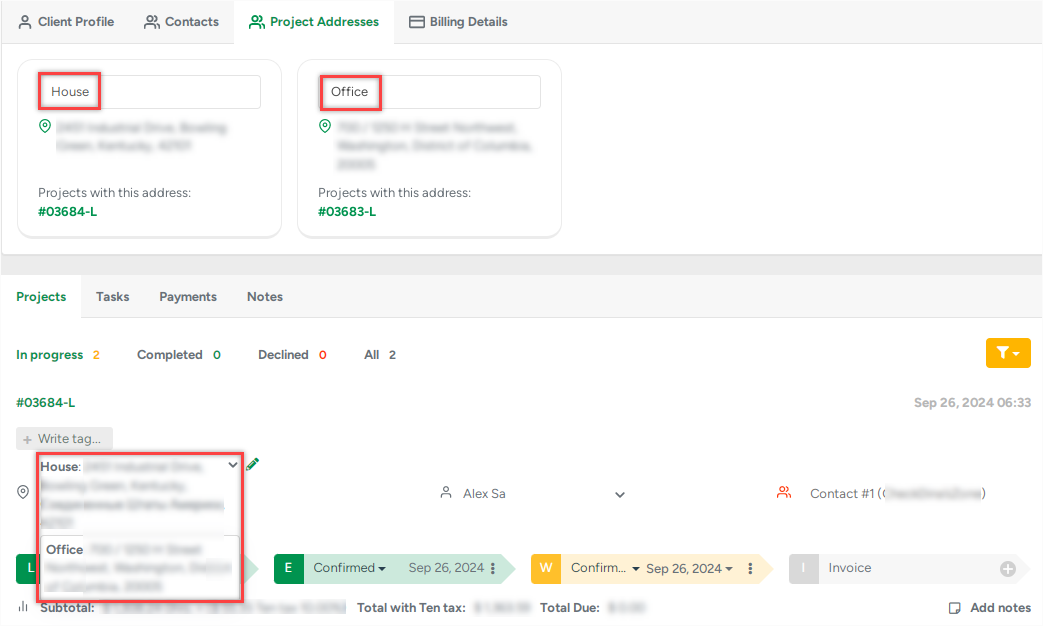
Click the pencil icon to open the Lead Address pop-up, where you can edit the address.
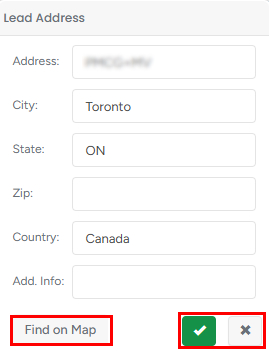
By clicking the Find on Map button, the Google Maps pop-up appears that allows set the location more precisely:
Billing Details
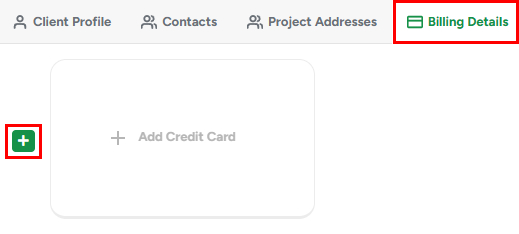
The Billing Details tab allows you to add and store the client’s billing information, such as credit card details, for use in future transactions.
To create a new billing record, click the + icon.
The client’s saved credit card information will appear on the screen. To make changes, click Edit billing information to expand the view.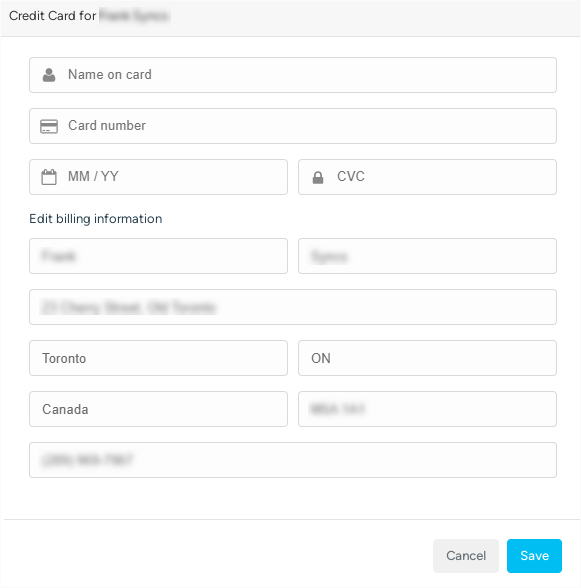
Sidebar Options
More options are available on the right side of the client profile:
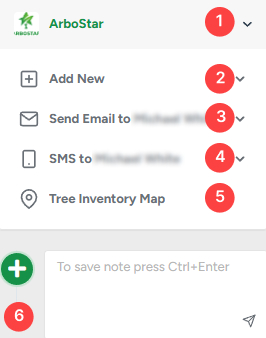
1. Select the service Brand for the client by clicking it to open the list of available brands.
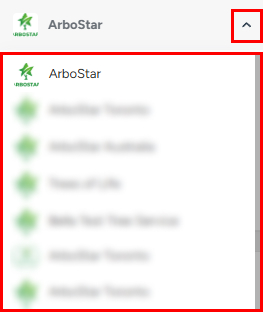
The expand option appears if there is more than one brand. When you switch the brand within a specific project, all company contact information will update accordingly on the Estimate and Invoice PDFs, as well as in the Customer Portal for that project.
2. The Add New expanded list.
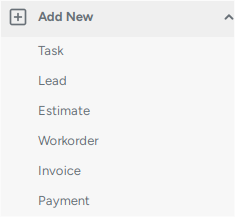
3. Send an Email to the client from the list of available options. By clicking it, the list of available Email templates opens.
4. Send an SMS to the client from the list of available options. By clicking it, the list of available SMS templates opens.
5. Navigate to the tree inventory map.
6. The text box (for notes) is located just under the sidebar panel, and it can be used to store additional client information.
- To add a note, please fill in the text and click Control + Enter.
- To remove the note, click on the bin icon under it.
Projects
The Project tab displays all existing projects, categorized by their status: In Progress, Completed, Declined, and All.
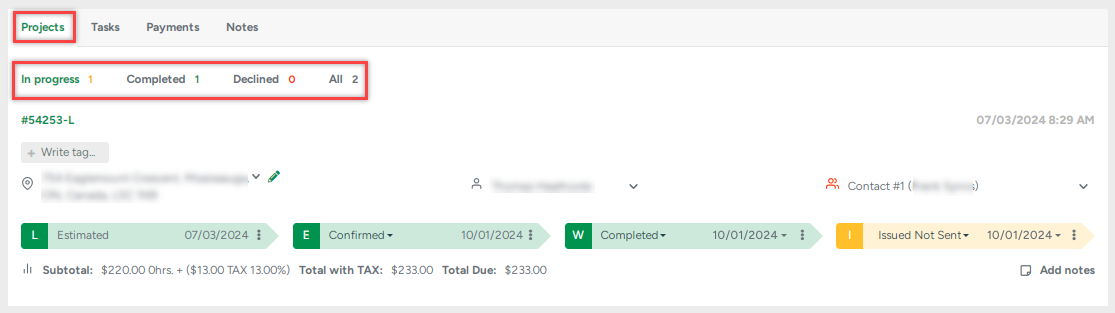
Newly created projects appear under Projects → In Progress. The project workflow is designed to help you easily track each project’s stage, assign contacts, and update the status of each step—all from a single page.
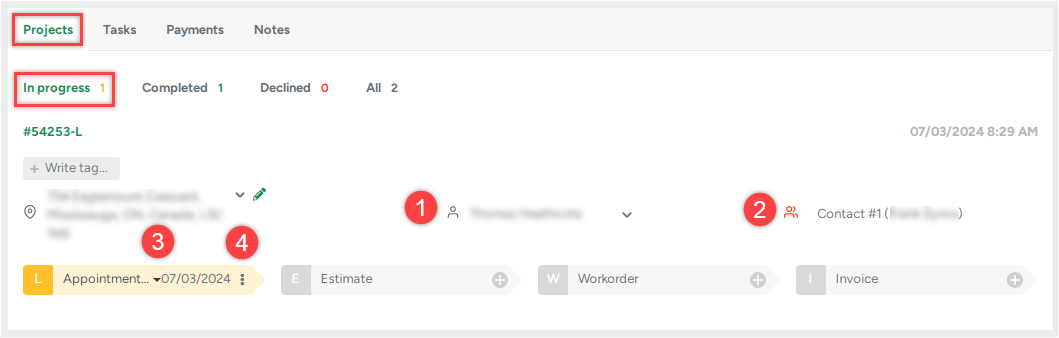
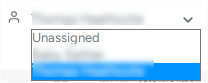
1. Assign an Estimator:
Click on the estimator’s name and select an employee from the list.
2. Assign a Contact:
Click the client’s name and choose a contact from the list (if multiple contacts are available).
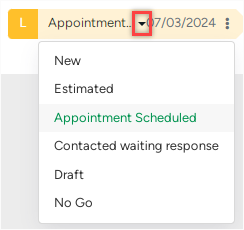
3. Change Project Stage Status:
To update the status of any project stage (e.g., Lead), click the drop-down menu and select the desired status.
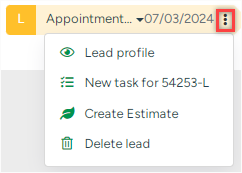
4. Access More Options:
Click the three-dot icon to open a pop-up menu with additional actions.
5. Open Profiles:
Click on the letter icons to open the corresponding profiles:
L for Lead
E for Estimate
W for Workorder
I for Invoice
6. View Workorder Schedule:
Click the date on the Workorder to see all jobs created, their scheduled dates in the Crew Schedule, and the assigned crews.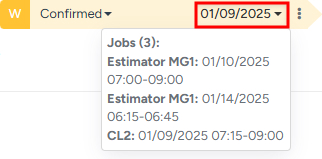
Project step shortcut
You can skip any project step, which can save time for office managers in certain situations. To manually create a skipped step, hover over the step icon and click the + sign that appears.
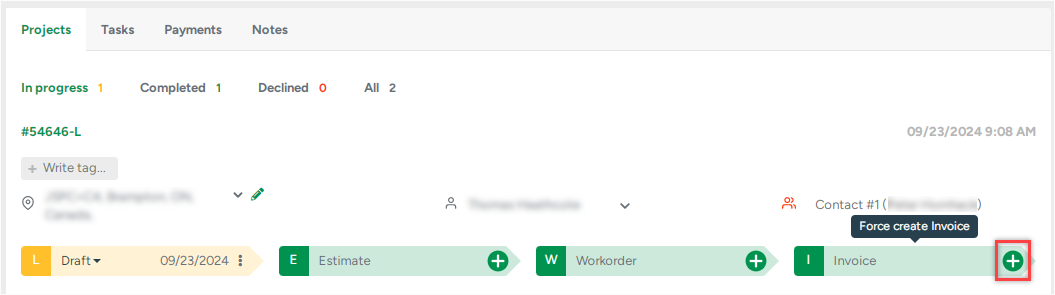
Sorting Projects
To improve project navigation, use the Sort By option. This dropdown appears next to all project tabs and is visible only when there are two or more projects listed.
Sorting Options:
By Creation Date (default)
Lead
Estimate
Workorder
Invoice
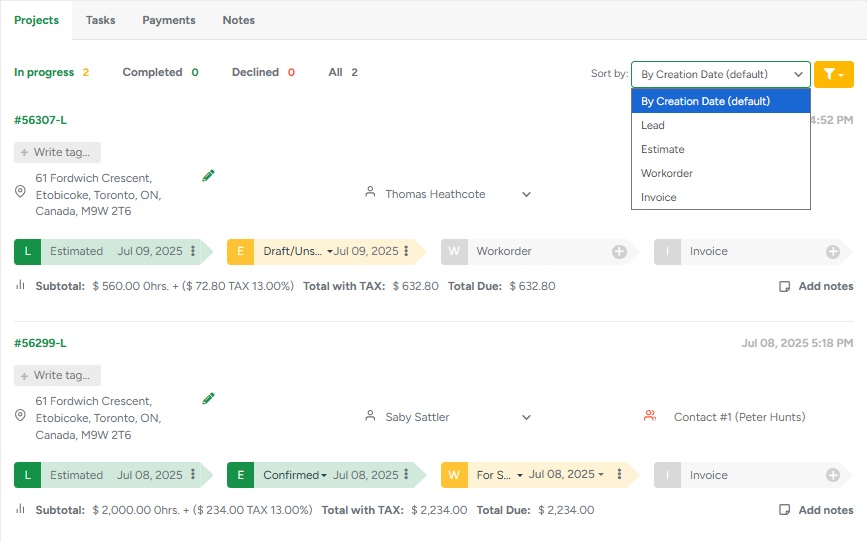
Sorting is applied per tab, meaning it only affects the list of projects in the currently selected tab. For example, if you're in the In Progress tab and sort by Invoice, it won’t change how projects are sorted in other tabs.
Each sorting option arranges projects by the most recently updated record of that type. For instance, selecting "Estimate" will sort projects by the most recent estimate. If a project doesn't have the selected item (e.g., no invoice), it will appear lower in the list.
When sorting by:
Lead, Estimate, Workorder, or Invoice – the most recently modified ones are displayed at the top.
Creation Date – projects are sorted by the original date they were created, regardless of their current status.
Projects without the selected item (e.g., a project without an invoice when sorting by invoice) are shown at the bottom, following this order: Invoice → Workorder → Estimate → Lead.
When a sorting option is applied, a standard loading spinner is displayed to indicate the change is in progress.
Tasks
Once tasks are created for a client, they appear in the Tasks tab within the client's profile.
For each task, you can:
Send an email to the client regarding the task
View details, update the task status, and add a description
Edit task information
Delete the task if no longer needed
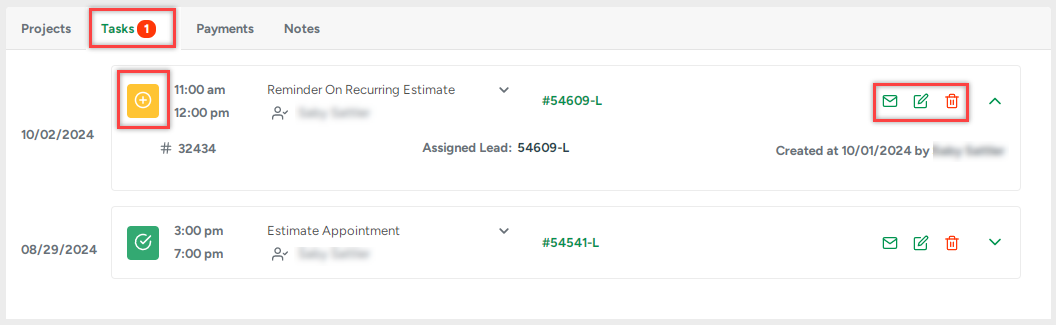
For more information on tasks, you can find it in our Create a New Task / Schedule Appointment article.
Payments
All payments made by the client are listed in the Payments tab of their profile. From there, you can edit or delete individual payment records.
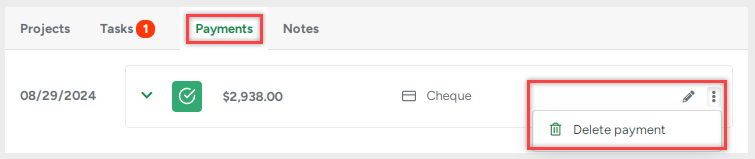
If a credit card was selected as the payment method during the payment creation process, clicking the three-dot icon allows you to view additional details or issue a refund.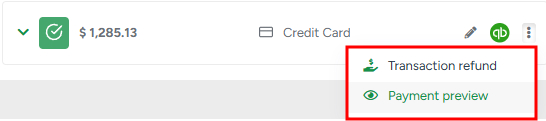
Here’s a sample payment preview: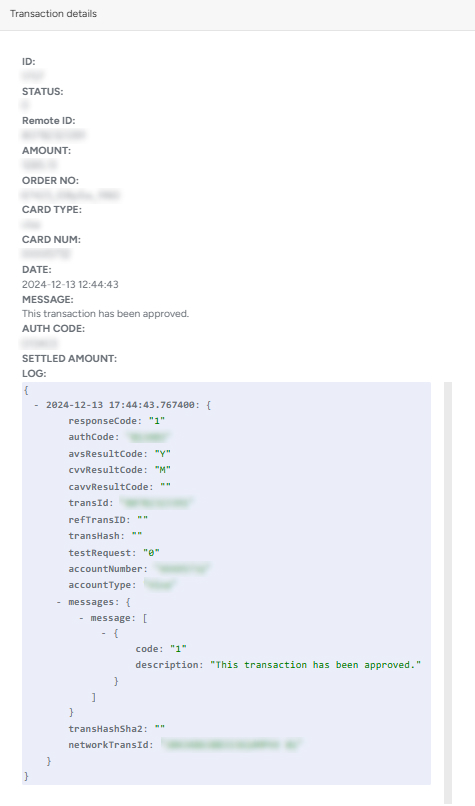
Notes
You can manually add notes and upload files to the client profile.
Click here for more information about Client Notes.the Brand's Settings